Fighting the Fires of Hate: America and the Nazi Book Burnings serves as a powerful reminder of what can happen when attempts are made to quash freedom.
It was May 10, 1933, when the Nazis (instigated by the German Student Association's Main Office for Press and Propaganda) burned over 35,000 volumes of "un-German" books, according to Wikipedia. In most university towns, students marched in torchlight parades 'against the un-German' spirit, with Nazi officials, professors, rectors and student leaders addressing the participants and spectators.
Besides those who wrote in opposition to the Nazi dogma, American authors such as Ernest Hemingway, Helen Keller and Jack London were also targeted. Joseph Goebbels, the Nazi Propaganda Minister, stated on that night, "...the soul of the German people can express itself again. The flames not only illuminate the end of the old era, they also light up the new."
Now, this traveling exhibit from the United States Holocaust Memorial Museum, which documents the event and the American response, is on display at Yavapai College, in the Art Gallery at the Performance Hall, exactly 75 years from the date of the first book burnings in Germany.
Bringing the Exhibit to Prescott
On Friday night, Dr. David Hess, President of the Jewish Community Foundation of Greater Prescott, explained how this exhibit came to Prescott, during the opening reception for the exhibit. "We had the good fortune of seeing this exhibit when it was in the Holocaust Museum in 2004 as a permanent exhibit, and then it was put in a temporary exhibit so it could travel around the country. We then saw it again when it was in Denver, and then we saw it again when it was in Scottsdale. And after seeing the exhibit several times, I said, 'I wonder what the people who put the exhibit together had in mind, because whatever it is, we want to understand that and teach it to our community.'"
Dr. David Hess, President of the Jewish Community Foundation of Greater Prescott, makes his opening remarks. Photo by Tracey Horn.
And, with that, Dr. Hess set out to find out how Fighting the Fires of Hate could be brought to Prescott. Hess continued, "So I called the Holocaust Museum and asked who put together the exhibit, and they said, 'A fellow named Dr. Guy Stern.' I said, well, give me his phone number. They said, well, he might not want to talk to you. I said, well the only way we're going to know is if I call him. So, I called Dr. Stern, and he picks up the phone right away, and I tell him who I am, I tell him what I want, and he graciously agrees to travel to Prescott..."
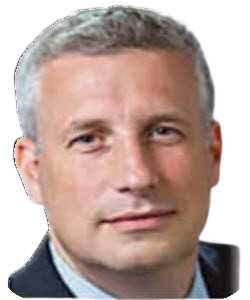
Upon meeting this remarkable man in person, Dr. Hess found that Dr. Stern had a personal story just as fascinating as the topic of his exhibit. Dr. Hess introduced Dr. Stern to the rest of the crowd, stating, "He is a most incredible and remarkable man. He was born in Germany, he was 11 years old when the books were burned in Germany, he escaped Germany in 1937, came to America and was one of 10,000 German Jews who joined the United States Armed Forces as a member of the US Army. And was trained at a place called Camp Ritchie, Maryland in military intelligence and counter-intelligence. And these gentlemen, known as the Ritchie Boys, because of Camp Ritchie, were the gentlemen who invaded with D-Day along with our troops, they interrogated captured prisoners, they became espionage experts, propaganda experts, and Dr. Stern as a war hero himself, had incurred a Bronze Star in his career in Europe. He then came back to America, got his PhD from Colombia in Germanic languages, and he's been a professor a provost, a teacher, a distinguished emeritus professor, at Wayne State University ever since."
Dr. Stern's Comments
As Dr. Stern spoke, the importance of this exhibit in recounting the cause of freedom became clear, "Yes, it is an historic moment, indeed. Seventy-five years ago on May 10th, 1933, a politicized group of German University students attempted and nearly succeeded to commit an act of collective cultural suicide. They torched books that, in the words of the American poet and writer, Steven Vincent Benét, constituted some of the finest examples of human philosophical and literary achievements. What stood in the way of the aims of these destructive students and their shameful professors as our exhibit abundantly makes clear, was the determined opposition of Americans, men and women of all walks of life, who said, 'We shall oppose all thought control by harboring the very works conscripted by the Nazis and we shall shelter their authors.'"
"Symbolically, so say it, the coruscating tortures of those arsonists were halted by the light of the torch held by the Statue of Liberty in Bedloe Harbor," Dr. Stern said. "A Jewish poet, Emma Lazarus, had given her voice to the voice of the statue a century ago. 'I lift my lamp of liberty beside the golden gate.' That was indeed the moment of palpable historic significance. That defense of liberty was reiterated exactly ten years later, when in a defense of freedom, and in defense of Franklin D. Roosevelt's four freedoms, including the freedom of thought and expression, American men and women halted the spread of Fascist evil. And while the Prescott sponsors held high the first defense of freedom of thought, by attracting to this gallery the exhibit Fighting the Fires of Hate; they simultaneously commemorated the mortal fight against oppression by honoring an exemplary soldier, the war hero, Ted Rubin. It seems totally fitting that the opening of the exhibits coincided, ladies and gentlemen with the arrival of a refugee from a Nazi concentration camp, who during WWII earned the Congressional Medal of Honor."
Dr. Stern discusses Fighting the Fires of Hate, America and the Nazi Book Burning.Photo by Lynne LaMaster.
So, how did Dr. Stern become involved in the topic of the book burning? "Personal history, ladies and gentlemen, attaches to world history. So, I failed to recognized the fact that fate was offering me a chance rarely dealt to the inhabitants of academic campuses, when Professor Walter [unintelliglble], preparing an exhibit and catalog for the 50th commemorative exhibit of the Book Burning in the City of Berlin, came to me and said, 'Here we are doing this exhibit at the principle site of the initial act of vandalism.' and he asked me to contribute to his project an article of the American reaction to the book burning. He wanted me to write an article for his catalog. Not knowing the first thing at that time on the subject, I turned him down. Only a week later, I realized that the topic and I were already on the road to a rendezvous."
Dr. Stern explained, "You see, I was realizing that the flames of the book burning had also lapped at my experience as a youngster. Two years after that bibliocaust of 1933, one of our German high school teachers in my hometown city came into our room and dictated to us, almost repeating, the incantations pronounced during the book burning that no Jew could produce German people's art. Another made us excise pages from our history textbook and insert substitute pages with a Nazi rewriting of history. We, on a school-free afternoon on the Sabbath, went to count the shelves of the last lot of the head library of our youth organization, found anti-Nazi books and burned them ourselves in order not to endanger our parents during the first wave of arrests by the Nazis."
"But, even so, I had no idea that to what extent this exhibit, as it came about, would enter into my life," Dr. Stern continued. "I could not foresee that my article would morph into two exhibits, in which I would be actively involved, one at the Library of Congress, and the other at the U.S. Holocaust Museum of which David spoke already. I will not bore you with the entire genesis of the exhibit, which ultimately from a simple article in a catalog book into this impressive travelling exhibit, now receiving such a magnificent exposure here in your gallery in Prescott."
But, even if I had known, it would not have made me more fervent in my attempt to be part of this. When I came here to Prescott, what I sensed in the groups that I addressed, was a devotion to this exhibit, an excitement, an ambiance of saying, 'Yes,' to an event that will touch many hundreds of lives as the docents will show this exhibit. Perhaps what caused this excitement, perhaps some of the originators of the idea were able to share their enthusiasm; perhaps it is something more basic, that we can extend the message of a poem by Robert Frost, who said, "Something there is that hates to see a wall." He speaks against the inhibition of communication. It's an elegant protest against walling off communication. In a similar way, there is something in us that hates to see the stifling of ideas in any form whatsoever, and doubly so through something as abhorrent as the burning of humanity's special heritage embedded in its books."
Fighting the Fires of Hate
Immediately prior to coming to Prescott, the exhibit was on display at the UCLA Library, and will head to Arkansas State University next. Prescott is the smallest venue for this prestigious exhibit.
For more information, or to schedule a guided time with a docent, please call 771.6157.
In addition, there is an online Book Burning Exhibit that includes community forum discussions, lists of works and further historical information.
"And so, I can tell you, that you, by opening this exhibit in Prescott, Arizona, you are extending your hand all across our nation, the testimonial to the surviving American devotion to the freedom of thought and expression, of upholding the First Amendment of our Constitution," Dr. Stern stated. "And with what have been able to observe, as the exhibit zigzags across our nation, is a ringing endorsement of our American principles. Perhaps the New York Times editorial put it best, it said, 'The Fires of Hate in 1933 were a cultural atrocity. The site of these fires should remind us that censorship, even when no books are set on fire, is in its very nature a violation against the essential freedom of thought and expression.'"
"But, David, since you invite an historical perspective," said Dr. Stern, "I will go back on the political scene, and quote... Robert Kerry, the former U.S. Senator from Nebraska, and briefly a candidate in the primaries for the presidency in 2004. He invoked our founding fathers when he said, '...Freedom must be defended especially against those who pretend to know what is good speech and what is bad, what is offensive and what is not, what is patriotic, and what is not. There will always be those who seek to silence dissenting views through intimidation.' This exhibit is a reminder of what might happen if we are not brave enough to stand up for those who try.'"
And, then Dr. Stern finished his remarks, "So I say to you in conclusion, these words were in our minds - and you wanted to hear what was in our minds - when we put together this exhibit of past history 75 years ago, and we hope that it will be a commemoration and a look at our future what we can't stand for, what our forefathers in this country stood for, and what we, as citizens can uphold. Thank you."